
Your cart
There are no more items in your cart
- News
- 0 likes
- 77 views
- 0 comments
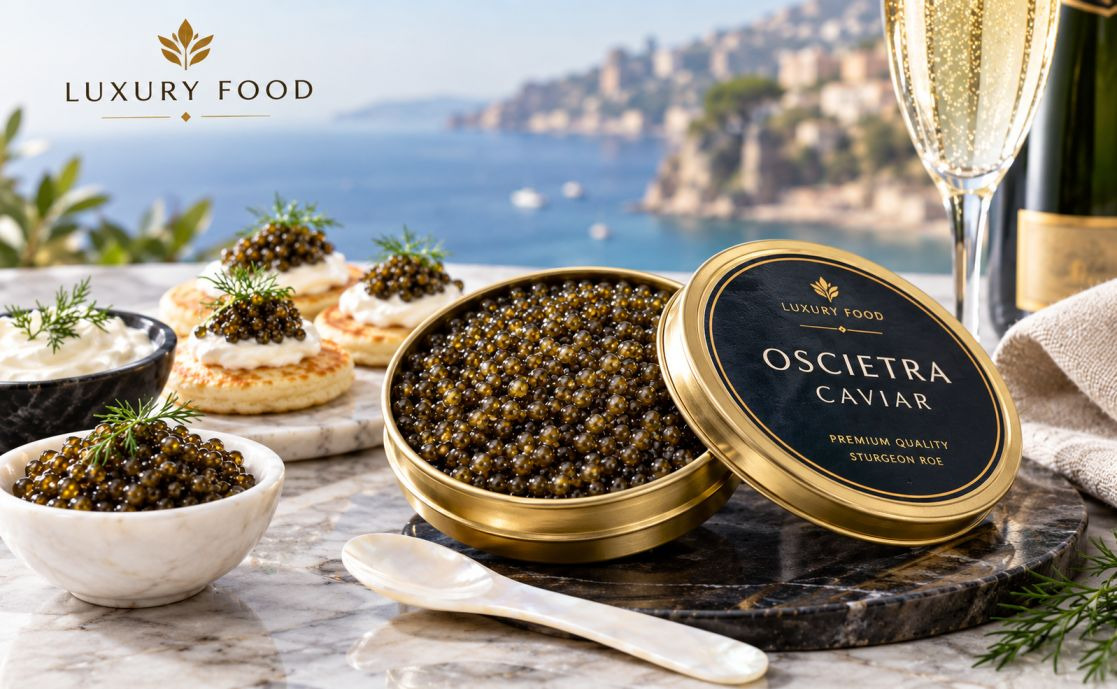
What Is Oscietra Caviar?
Oscietra caviar is one of the best-known varieties of sturgeon caviar, traditionally associated with the Russian sturgeon, Acipenser gueldenstaedtii. It is valued for its medium-sized pearls, firm texture and distinctive flavour, which can combine nutty, buttery and gently briny notes.
The name can appear in several forms, including Oscietra, Osetra and Ossetra. While the spelling varies between markets, these names are commonly used for the same caviar style. The species has historical associations with the Black Sea, Caspian Sea and Sea of Azov regions, while much of today's premium sturgeon caviar is produced through controlled aquaculture.
The quality of Oscietra caviar is not determined by a single characteristic. Pearl size, colour, firmness, appearance, flavour and processing all contribute to the final product. The pearls can vary in colour from grey and dark grey to golden or amber shades, depending on the sturgeon and production.
Traditional caviar is lightly salted to preserve the roe while allowing its natural character to remain prominent. This style is commonly described as Malossol, a term used in the caviar trade for lightly salted roe.
What Does Oscietra Caviar Taste Like?
The flavour of Oscietra is generally more complex than simply salty or fishy. High-quality examples can have a nutty, creamy and mildly briny character, with a clean finish.
Sensory research on sturgeon caviar has identified butter, hazelnut and briny flavours among the characteristics that help distinguish caviar products. Specialist tasting notes for A. gueldenstaedtii also describe combinations of fruit, nuts, buttery richness and balanced marine flavours.
The exact flavour depends on factors such as the sturgeon, farming environment, maturity and processing. This means two Oscietra caviars can belong to the same category while still having noticeably different tasting profiles.
For the Italian Oscietra offered by Luxury Food, the tasting profile is described as soft and almost nutty, with an elegant aromatic character and a creamy finish.
What Does Oscietra Caviar Look Like?
Oscietra pearls are generally medium-sized, although their exact size varies according to the product and sturgeon.
The colour can range from pearl grey and dark grey to golden or amber tones. Colour alone does not determine quality; pearl integrity, texture, flavour and overall processing are also important considerations.
The Luxury Food product has an egg size of approximately 2.8–3.0 mm. Its pearls are described as well defined, solid and generally well shelled.
Why Is Oscietra Caviar Considered Special?
Part of Oscietra's appeal comes from the balance between its texture and flavour.
The pearls should retain their structure while giving a pleasant release of flavour when eaten. Unlike caviar that is valued mainly for large eggs, Oscietra is particularly appreciated for its distinctive nutty character and satisfying texture.
Its reputation also comes from its sturgeon heritage. Acipenser gueldenstaedtii is one of the species historically associated with Osetra caviar, and its roe has long been recognised as one of the classic categories of sturgeon caviar.
Is Oscietra the Same as Osetra Caviar?
Yes, in most commercial contexts, Oscietra and Osetra refer to the same type of caviar.
You may also encounter the spelling Ossetra, Osietra or Asetra. These variations developed through different languages and transliterations. Official European fish-name records list several of these terms for Acipenser gueldenstaedtii, while the FDA's substance database also lists Oscietra, Osetra and Ossetra as synonyms associated with Russian sturgeon roe.
For consumers, this means there is generally no need to treat “Osetra Caviar” and “Oscietra Caviar” as two completely different products simply because the spelling is different.
How Is Modern Oscietra Caviar Produced?
Historically, Osetra caviar was associated with wild sturgeon from the Caspian, Black and Azov Sea regions. However, the decline of natural sturgeon populations has made aquaculture increasingly important for caviar production.
Farmed sturgeon are raised in controlled environments where producers can manage water conditions, feeding and fish health. When the roe is ready, it is carefully processed and salted before being packed for storage and distribution.
This controlled approach allows premium producers to maintain more consistent characteristics from one production cycle to another while reducing dependence on wild sturgeon populations.
What Are the Characteristics of Premium Oscietra Caviar?
When assessing an Oscietra caviar, several details are worth considering:
- Species: The label should identify the sturgeon species.
- Pearl size: Medium-sized pearls are characteristic of many Oscietra products.
- Colour: Grey, dark grey and golden or amber tones can occur.
- Texture: The eggs should remain well defined rather than appearing crushed or excessively soft.
- Flavour: A balanced combination of nutty, creamy and lightly briny notes is desirable.
- Processing: Salt level and handling can significantly influence the final taste and texture.
- Storage: Caviar requires careful temperature control to maintain quality.
The Italian Oscietra available from Luxury Food has 2.8–3.0 mm pearls, pearl-grey to dark-grey colouring with possible golden tones, and a solid, well-defined texture. Its listed ingredients are sturgeon eggs, salt and preservative E285.
How Should Oscietra Caviar Be Served?
Oscietra is best served chilled and with simple accompaniments that do not overpower its flavour.
It can be enjoyed on its own to appreciate the texture and finish, or served with traditional accompaniments such as blinis and crème fraîche. A non-reactive spoon, such as mother-of-pearl, is commonly preferred when serving caviar.
For the Luxury Food Oscietra, the recommended pairings include Champagne and structured sparkling wines, while dry gin with citrus and floral notes is another suggested combination.
The simplest approach is often the best: keep the accompaniments subtle and allow the caviar to remain the main flavour.
How Should Oscietra Caviar Be Stored?
Caviar is a delicate chilled product and should remain refrigerated according to the producer's instructions.
The Luxury Food product specifies a storage temperature of 0°C to 7°C and lists a three-month refrigerated conservation period. Once opened, it is sensible to consume the caviar promptly and keep the container properly chilled.
Storage conditions matter because temperature changes can affect the freshness, texture and overall tasting experience.
Oscietra Caviar for Fine Dining
Oscietra works particularly well when the goal is to create an elegant dish without adding too many competing flavours. Its medium-sized pearls, creamy texture and nutty character make it suitable for tasting on its own, serving with classic accompaniments or pairing with carefully selected sparkling wines.
For those looking for an Italian expression of this classic sturgeon caviar, Luxury Food offers Premium Oscietra Caviar with 2.8–3.0 mm pearls from Acipenser gueldenstaedtii, featuring a refined creamy and nutty profile. It is an elegant choice for fine dining, celebrations and special occasions.
Frequently Asked Questions
Is Oscietra caviar made from Russian sturgeon?
Oscietra is traditionally associated with Russian sturgeon, Acipenser gueldenstaedtii. The species is one of the principal sturgeons historically associated with Osetra caviar.
Is Oscietra the same as Osetra?
Yes. Oscietra and Osetra are common spelling variations for the same caviar category. Ossetra, Osietra and Asetra may also be used in different markets.
What size are Oscietra caviar pearls?
Pearl size varies by product. The Italian Oscietra product discussed here has pearls measuring approximately 2.8–3.0 mm.
What colour is Oscietra caviar?
Oscietra can range from grey and dark grey to golden or amber shades. Colour varies naturally and should be considered alongside texture, flavour and pearl integrity.
What does Oscietra caviar taste like?
It is commonly associated with nutty, creamy and mildly briny flavours. Some examples can also show buttery, hazelnut or other subtle aromatic notes.
Comments (0)